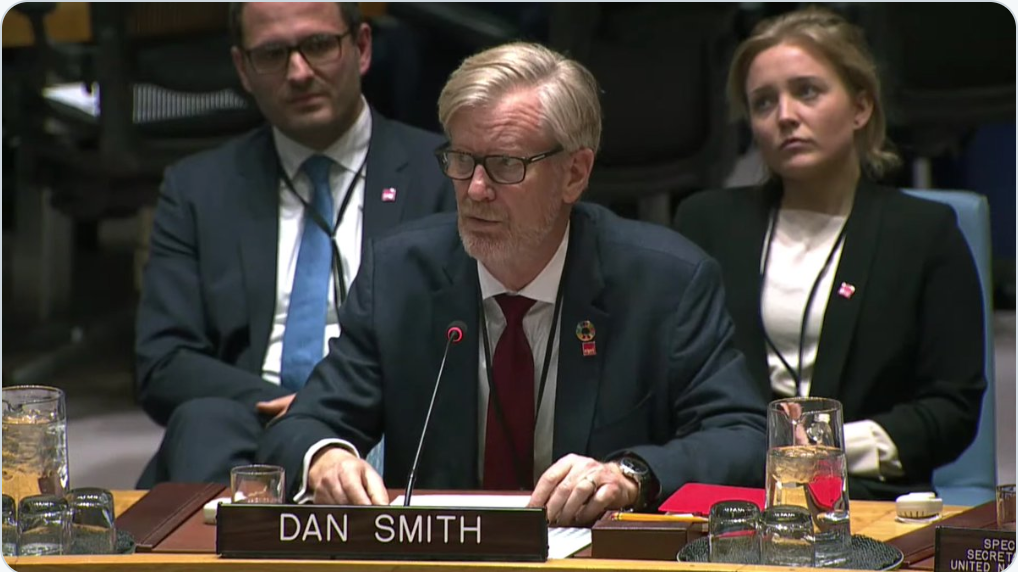
The SIPRI Yearbook 2019 is now available on line. It registers key data in the world of peace and security in 2018 and establishes some of the basic indicators that let us track and assess the trends. It is not a comfortable picture.
You can get a quick take on it from my shorthand overview below and/or from the latest short film in our Peace Points series.
There we are, another year, full of puzzlement and uncertainty. Some things moving forward (détente on the Korean peninsula, peace talks at last about Yemen), others regressing (world hunger on the rise, arms control crumbling, impacts of climate change unfolding), and other things hard to interpret. In this short film, the closing one of 2018 in SIPRI’s Peace Points series, I give my view. in the first one of 2019, I will take a look ahead at hopes for the coming year.
For 2018, I don’t really have a total on the bottom line of the balance sheet. The question that gets put at the beginning is, are we moving towards or away from midnight on the Doomsday clock? And my answer is a cross between ‘I don’t know’ and ‘Neither’ (i.e., no movement for either good or bad).
Happy (and PEACEFUL) New Year greetings to everyone!
At a political rally on Saturday 20 October President Trump announced that the US will withdraw from the Intermediate Nuclear Forces (INF) Treaty of 1987. This confirms what has steadily unfolded over the last couple of years: the architecture of US-Russian nuclear arms control is crumbling. Continue reading →
On Friday 5 October, the Norwegian Nobel Peace Prize Committee announced the laureates for 2018: Nadia Murad and Dr Denis Mukwege. These are two extraordinary people, brave, articulate and committed. Both Ms Murad and Dr Mukwege know atrocity close up. Both work to help the victims of wartime sexual crimes and, by denouncing the crime, helping to end it.
Around the world, a series of new “hottest ever” local records have been set. Africa has experienced what is probably its hottest ever daily temperature. The world’s highest “daily minimum” temperature (i.e., the lowest temperature in that 24-hour period) has been recorded – over 42°C in Oman, for those of you trying to handle a modest mid-30s of an afternoon by the Med. Northern Arctic sea ice is breaking up for the first time on record. What are the trends and what are the implications for peace and security? Continue reading →
That was a surprise. The Sentosa Island summit on 12 June between President Trump and DPRK leader Kim Jong-un produced an undramatic yet hopeful agreement. Quite a turn-up for the books, coming from two leaders famed for unpredictability. But components of the summit outside of the signed agreement showed Trump continuing to be a disruptor in world politics. Continue reading →
As we wait for the summit meeting between US President Donald Trump and DPRK Supreme Leader Kim Jong-un to unfold on Sentosa Island in Singapore, everyone is in waiting mode and there are few takers for the challenge of forecasting the outcome. There is a widespread sense of a precarious balance between the epoch-shaping risks and opportunities available, uncertainty about what two unpredictable leaders would achieve together or, indeed, wreck. The uncertainty was only deepened by the US President’s rejection of the agreed communiqué at the G7 summit in a Quebec village three days earlier.
On Saturday 7 April came reports that chemical weapons (CW) were used in Douma, Syria. In the very early hours of Saturday 14 April the US, France and the UK launched 105 cruise and air-to-surface missiles against a CW research centre and two CW storage facilities. US President Donald J Trump tweeted “Mission Accomplished!” But what was the mission? Continue reading →
The seventh Moscow Conference on International Security (MCIS) was on Wednesday 4 and Thursday 5 April. Listening to the speeches and chatting with various people during and after it, my first thoughts concern three related issues: the growing confidence of Russian policy; soft power; and shared concern about the increasing risks in global politics, together with deep differences about where those risks come from. Continue reading →