The Gaza peace plan after 7 weeks: 3rd assessment

IT IS TWO MONTHS since the Gaza peace plan was announced (29 September). A few days later, Hamas gave its conditional acceptance of the deal (3 October). On 8 October, the negotiators agreed a ceasefire, which was formally approved by the Israeli cabinet the next day. Implementation started on Friday 10 October.

This post is my third on the peace plan. As in the first and second, my aim is to assess it as a plan. I am not asking whether it was right or wrong, fair or unfair, but would it work? So, seven weeks in and one month after my last assessment, how is it doing?

Continue reading

The Gaza peace plan, 2 weeks in: continuing assessment

On 8 October, two years and one day after Hamas’s savage incursion into Israel that triggered Israel’s hyper-destructive onslaught on Gaza, US Secretary of State Marco Rubio passed a note to President Trump in the middle of a press conference, then whispered to him to say he could announce that a ceasefire had been agreed.

So began the implementation of the 20-point Gaza peace plan that Trump had announced at the White House on 29 September. Discussion followed between Israel, Hamas and other interested parties – the USA, Egypt, Qatar, Turkey and doubtless many others via standard diplomatic channels. On 3 October, after Trump set a 5 October deadline for Hamas to accept the plan or suffer “all hell”, Hamas agreed to release the remaining hostages it had held for two years, including the bodies of the dead, and repeated what it had said before, that Gaza could be run by a technocratic administration as Trump’s peace plan envisaged. As multiple news outlets reported, this was a partial acceptance – a “yes but” rather than full-blown consent. While Trump threatened Hamas with “complete obliteration” if it refused to fit in with his plan, the Israeli bombardment of Gaza continued, and negotiators met in Sharm el-Shaikh, Egypt, to get the peace plan on the road.

Two weeks after Rubio whispered in his President’s ear, how is the plan doing? I gave my view of it before there was any action, aiming to assess it as a plan, in its own terms, asking not whether it was right or wrong, fair or unfair, but would it work? It is what you could call a negotiations perspective, a technical assessment. In the same vein, two weeks in, how does it look now?

Continue reading

Evaluating President Trump’s Gaza peace plan

The fate of the peace plan for Gaza announced at the White House on Monday 29 September is not yet decided. Because Hamas accepted the hostage return part of the proposed deal, while seeking negotiation of other parts, US President Trump ordered Israel to stop bombing. It did not immediately do that though the Prime Minister’s office said it was preparing for “immediate implementation” of the first stage of the plan.

There has, of course, been considerable coverage of the plan in the news media. Some focusses on its prospects, including the impact of divisions within Hamas about it, along with the matter of whether Trump will impose a deadline for Hamas’ acceptance and how long it might be. There has been some coverage of gaps and uncertainties in the plan and plenty of advocates have been out there to disparage or support the plan. And there’s been quite some discussion about whether President Trump prevailed over Israeli Prime Minister Netanyahu in crafting the plan, or the other way round.

But, so far as I have seen, there has been little dispassionate coverage of whether it is actually a good plan, whether it will work. So this post is my clause-by-clause assessment of the Gaza peace plan.

Peace is a tricky business. An 1100 word document containing 20 points is not a treaty, is not legally binding, and is bound to contain a number of generalities and broad statements of intent. That leaves plenty of room for uncertainty to creep in. Nonetheless, it is a serious document and not the first one to address how to end the war in Gaza. It builds on the never-implemented January 2025 agreement, which itself built on the never-implemented May 2024 agreement. With those foundations, there ought to be some key issues on which there is clarity but there should also be some latitude for uncertainty, interpretation and further discussion.

In sum, not surprisingly, what comes out is mixed – some strengths, some weakness, some areas of clarity and some confusion.

Continue reading

World order §4: Conflict management in a disordered world: the Security Council and Gaza

During the 2020s, on current trends, four times as many people (or more) will die in war as in the first decade of this century. Since 2010, the number of armed conflicts each year has almost doubled. The number of refugees has more than doubled in the same period. Meanwhile the world spends vastly more on the military than ever before, 2.443 trillion US dollars in 2023, compared to about 1.1 trillion at the start of the century.

What is going on? What has happened – is happening – to the world and to conflict? How come conflict management doesn’t seem to be working any more?

This post is number 4 in a series, based on the introductory chapter to the recently released SIPRI Yearbook 2024, asking, What world are we shaping for ourselves in the coming decades if these trends continue unchanged? 

Continue reading

Is peace possible in Ukraine?

Well, yes, of course it is. All that is needed to start the process is that Russia, which started the war with its invasion, decides not to continue and pulls back.

That’s all that’s needed to start a peace process. But much more will be needed to sustain it and generate a real peace in Ukraine and between Russia and Ukraine. Much more and many years and the process will always be fragile.

I had the pleasure (or perhaps the pressure) of being questioned about this by Alexander Wolf as part of the 17 Academy project (titled after the 17th UN Sustainable Development Goal on partnerships to change the world) of the AusserGewöhnlich Foundation in Berlin.

You can link to the podcast using Spotify or Apple.

Continue reading

Compound risk, response and prevention: learning to act where problems intersect

The Stockholm Forum on Peace and Development is co-convened annually by the Stockholm International Peace Research Institute (SIPRI), which I have the honour to lead, and Sweden’s Ministry of Foreign Affairs. This year ‘s Forum was held in early May. Like the 2020 edition, it was online. The theme was Promoting Peace in the Age of Compound Risk.

The Forum was big. This post offers some summary reflections about what was discussed and what those discussions tell us about the way ahead.

Continue reading

Climate change, security, the UN – and EVIDENCE

All eyes are on the Covid-19 pandemic and the unfolding crisis it is causing, whose full dimensions are not yet clear. Meanwhile, there’s the climate crisis. It too has multiple, unfolding impacts about whose full details we cannot yet be sure. We should not lose sight of it, of course, and not only because it is very, very important. Some of what we are are (or should be) learning from the pandemic is relevant to the climate crisis, not least the widespread deficiency in resilience that Covid-19 is revealing.

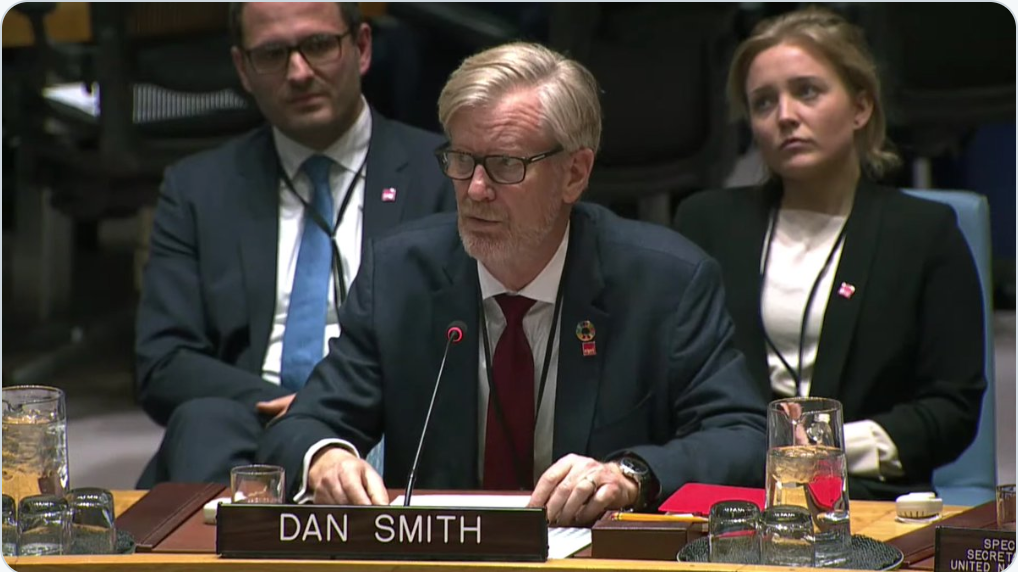
At French initiative, the UN Security Council held what is known as an Arria Formula debate on 22 April. This is a relatively informal meeting so the Council can be briefed on and discuss major issues. The meeting was virtual and I joined Under-Secretary-General Rosemary DiCarlo and International Crisis Group President, Robert Malley, to provide the initial briefings, after which some 23 representatives of member states plus the representatives of the African Union and the European Union also spoke.

Here, in more formal tones than I normally use in this blog but rather less formally than my last UNSC briefing in February, is what I said.

Continue reading

Somalia – a difficult climate for peacebuilding

Somalia is showing encouraging signs of emerging from three decades of chaos and mayhem that themselves followed two decades of dictatorship and one of civil war. Problems abound still and there are over 5 million people in the country who need humanitarian assistance and well over 2 million displaced people. As well as trying to win territory back from the al-Shabab terrorists, the government and its regional and international supporters have to meet people’s basic needs, develop the economy and establish some kind of political normalcy with critically elections planned for this year.

Exerting pressure on all this and making it harder is climate change and an average of one natural disaster a year for the last 30 years ( 12 serious droughts and 18 major floods). SIPRI published a report in late 2019 – Climate-related security risks and peacebuilding in Somalia by Florian Krampe and Karolina Eklöw – and the Belgian Presidency of the UN Security Council invited me to brief the Council about the issues on 24 February as part of their session on the situation in the country.

What follows – in perhaps a somewhat more formal tone than readers of this blog are generally used to – is what I said in my briefing.

Screenshot 2020-02-25 at 03.43.01

Continue reading

Whither Peace?

Today is the UN International Day of Peace and it comes at a time when many people seem to feel peace is taking a horrible worldwide kicking. Is it so bad? Continue reading

Peacebuilding: the importance of institutions

The Conflict, Security and Development Conference is run by students at King’s College London. This year they asked me along to give the closing keynote and thoughtfully interviewed me beforehand so I could run through some of my main points. The interview falls into three sections: the first is on the central importance of institutions in building peace, the second on the role of NGOs like International Alert, and the third on the sort of challenges to peace and security that lie ahead, the compound risks we face in the coming decade and beyond.