During the 2020s, on current trends, four times as many people (or more) will die in war as in the first decade of this century. Since 2010, the number of armed conflicts each year has almost doubled. The number of refugees has more than doubled in the same period. Meanwhile the world spends vastly more on the military than ever before, 2.443 trillion US dollars in 2023, compared to about 1.1 trillion at the start of the century.
What is going on? What has happened – is happening – to the world and to conflict? How come conflict management doesn’t seem to be working any more?
This post is number 4 in a series, based on the introductory chapter to the recently released SIPRI Yearbook 2024, asking, What world are we shaping for ourselves in the coming decades if these trends continue unchanged?
Peace and the UN Security Council
In 2005, the Human Security Report analysed possible explanations for the welcome decline in the number, length and lethality of armed conflicts in the previous decade. Having tested a variety of hypotheses, the report concluded that the key reason was that the end of the Cold War meant there were no more logjams in the UN Security Council, freeing up the UN to be a more effective peacemaker and peacebuilder. By this analysis, the degree of consensus in the Security Council is a major determinant of the prospects for peace worldwide. The return of infighting and deadlock in that forum because of growing differences between Russia and the West and between China and the West over a range of issues, including arms control and Russia’s actions in Ukraine since 2014, is therefore a major problem for peace and security everywhere.
Given the problem, some argue that the best way forward is through procedural UN system reforms, such as increasing the number of the Security Council’s permanent members. This proposal is no longer especially controversial, even among the current five permanent members, although there is no consensus on the details so moving forward is not simple.1 The effect of enlarging the Security Council is also debatable as increasing the number of permanent members could make consensus harder to achieve. This raises questions about the acceptability of a few states—even if more than today—having the right of veto. An alternative approach seeks a stronger role for the UN General Assembly, in which decisions are taken by majority with no state having a veto.
These issues are important because they concern how power is or could legitimately be distributed within the UN. The downside is that, precisely for that reason, they are unlikely to be resolved quickly. As one analyst has commented, ‘Few topics generate so much talk and so little action as Security Council reform.’[
If the problem of the disorderliness of the world were limited to the UN Security Council, however, it might be regarded as relatively self-contained even if frustratingly hard to solve. But the problem goes wider and deeper. To understand why, having looked at Ukraine earlier in this series, consider Gaza.
Gaza
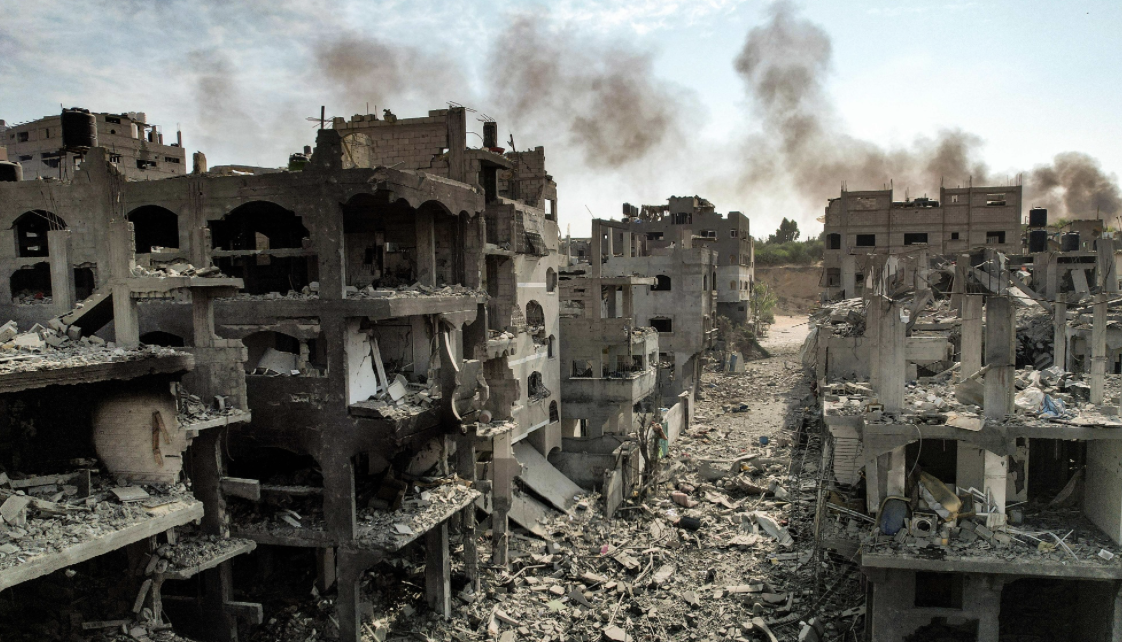
On 7 October, Hamas forces breached the border between Gaza and Israel and carried out what has been estimated to be the third most lethal terrorist attack of all time. The attackers killed 1200 people and took 251 hostage. Israel’s response began with a bombing campaign that ranks among the most severe civilian punishment air campaigns in history. It far exceeded a proportionate response and started to look more like revenge against Palestinians or collective punishment than retaliation against Hamas. By the end of January 2024, satellite data analysed by the BBC showed that more than half of Gaza’s buildings had been destroyed. As well as the overall level of urban damage, some observers regard Israel’s destruction of health facilities and the refusal of access for humanitarian aid as prima facie violations of international law. In July 2024, the direct death toll in Gaza was estimated by the Health Ministry to be over 38.000.2 However, violent conflicts also cause death indirectly through the destruction of health facilities, clean water supplies, food systems and shelter. An analysis published in the UK medical journal Lancet estimated conservatively that, by mid-June, the combined direct and indirect death toll in Gaza was in the region of 186,000.
The actions of both Hamas in its October attack and of Israel in its response breach humanitarian law and basic ethical norms and standards; more on that in my next post.
The war in Gaza is but the latest phase of a long-running conflict. Hamas has made clear its view that its attack in October 2023 was a product of that conflict and a necessary response to its development to that point, in particular to the conflict being side-lined and the rights of Palestinians ignored. There is no moral basis for accepting that Hamas’s response had to take the form that it did, but it can hardly be refuted that the denial of Palestinian rights and statehood is a fundamental part of the conflict. Moreover, the situation of Palestinians in Gaza was increasingly hard to bear and there were warning signs in September 2023 that tensions were beginning to boil over. At the same time, violence in the West Bank was already getting toward its highest level since the end of the second Intifada in 2005.
In contrast to this picture of a desperate situation in Gaza and rising violence in the West Bank, US National Security Adviser Jake Sullivan contended, just before the Hamas incursion, that ‘The Middle East region is quieter today than it has been in two decades’. As the basis for that assessment, he cited events relating to Iran, Iraq and Yemen; his remarks seemed to treat ‘tensions between Israelis and Palestinians’ as residual problems, acknowledging their existence but not their depth and urgency. Of course, retrospective knowledge is a wonderful thing. There is nonetheless clear evidence in Sullivan’s words of either ignorance or denial at a high level in the US administration of the structural underpinnings of the risk of imminent escalation.
The degree to which Israel’s government, military and intelligence services were taken by surprise by the Hamas incursion might suggest that the same problem of ignorance or denial was to be found there. But that is only part of a mixed picture. Reports in Israel indicate that the country’s military, intelligence service and government knew for a decade about a Hamas plan to attack Israeli communities and kill and kidnap civilians on the scale seen in October 2023. It is likely, of course, that this knowledge was not available to everybody and all departments, even within security establishment. But it seems incontrovertible that some knew and could have acted to prevent.
The apparent failure to act on this intelligence appears in a harsher light when placed alongside reports dating back to 2009 that Israel under the leadership of the current prime minister, Binyamin Netanyahu, actively supported Hamas in order to weaken the Palestine Liberation Organization and the Palestine Authority.
Playing one faction against another has been a feature of power politics since antiquity. History provides many examples of this brutal pragmatism turning out to be unrealistic and counterproductive. The Hamas attack on 7 October 2023 is the latest.
The Netanyahu government’s assumption was that Hamas was a problem it could manage and control, which turned out to be dangerously untrue – first for Israel, and then for Gaza. In Russia, President Putin’s assumption was that Russia had the right and the means to take Ukraine, which was also untrue and has resulted in a protracted war that has brought death, grief and misery to tens of thousands of families in both Russia and Ukraine.
If the problem of the disorderliness of the world were limited to the UN Security Council, it might be regarded as relatively self-contained.
Summing up the problem
In sum, the current world order is deficient in conflict management not only because of the lack of unity of purpose among its leading powers, but also (see my earlier post) because of the structure of many of today’s conflicts, and because of the way conflict is driven to the point of explosion by misplaced, misdirected and counterproductive actions by key governments and armed groups, and their leaders. Similar arguments, with a similar balance between the structure of causality and the role of individuals and their decisions, can be advanced in relation to so many other conflicts.
It is difficult to see how reform of the United Nations could address these parts of the problem, regardless of its possible desirability for other reasons.
To try to reduce the scale of the problem of armed conflict in the short term, what is needed is a change in behaviour – at the global level to reduce the toxicity of geopolitics, in the UN for a bit more boldness in trying to address the task of reducing the level of conflict worldwide, among the conflict parties and their leaders themselves. To build a more peaceful world in the longer term, that is possible only if there is greater justice and fairness, reducing fundamental inequalities of wealth, power and voice. Along that road, reforming the UN will not be the key ingredient of change but would be no bad thing.
Notes
- See the following links for expressions of the views of the five permanent members of the UN Security Council: China, France, Russia, UK, USA.
- Despite claims that the Gaza Health Ministry’s information on the death toll in Gaza is unreliable and distorted, it has been reported that those figures from that source that are used by Israeli intelligence in its own assessments of the war in Gaza.
 Dan Smith's blog
Pingback: World order §6: Ecological disruption and cooperation | Dan Smith's blog