World order §7: Shared vulnerabilities demand cooperation

My previous post makes an argument that regular readers of this blog will find familiar: the challenge of ecological disruption including climate change crosses national boundaries and can only be tackled by international cooperation. It is not a problem that any single country, however rich, can solve alone. It is the superordinate challenge of our time and one part of the difficulty of rising to it is that, at the very time when we need a world order with strong institutions encouraging, facilitating and streamlining international cooperation, they are weakening. Deteriorating relations and increasing hostility between the great powers and their respective allies are undermining the ability of world order institutions to protect peace and security and get in the way of working productively on climate change and other issues. In the face of that, how can we do cooperation?

To the pessimism that might produce, I have a simple response. If international cooperation is necessary it has to be possible because the alternative is unacceptable. And if it is possible on the ecological crisis, I’m now going to argue, it’s possible in other areas as well.

This post is the next to last in a series on the shaky state of the world order. It is based on the introductory chapter to the recently released SIPRI Yearbook 2024.

Continue reading

World order §6: Ecological disruption and cooperation

Researchers, commentators and policy-makers are increasingly aware of the negative effects of climate change for peace and security. Climate change undermines conditions for peace and security for all, while increased conflict, disputation, instability and disorder add to the difficulties of arriving at agreements to slow down global warming. When we think about peace and security and about world order, climate change – and, by extension, the full spectrum of ecological disruption – should be in the centre of our attention.

Continue reading

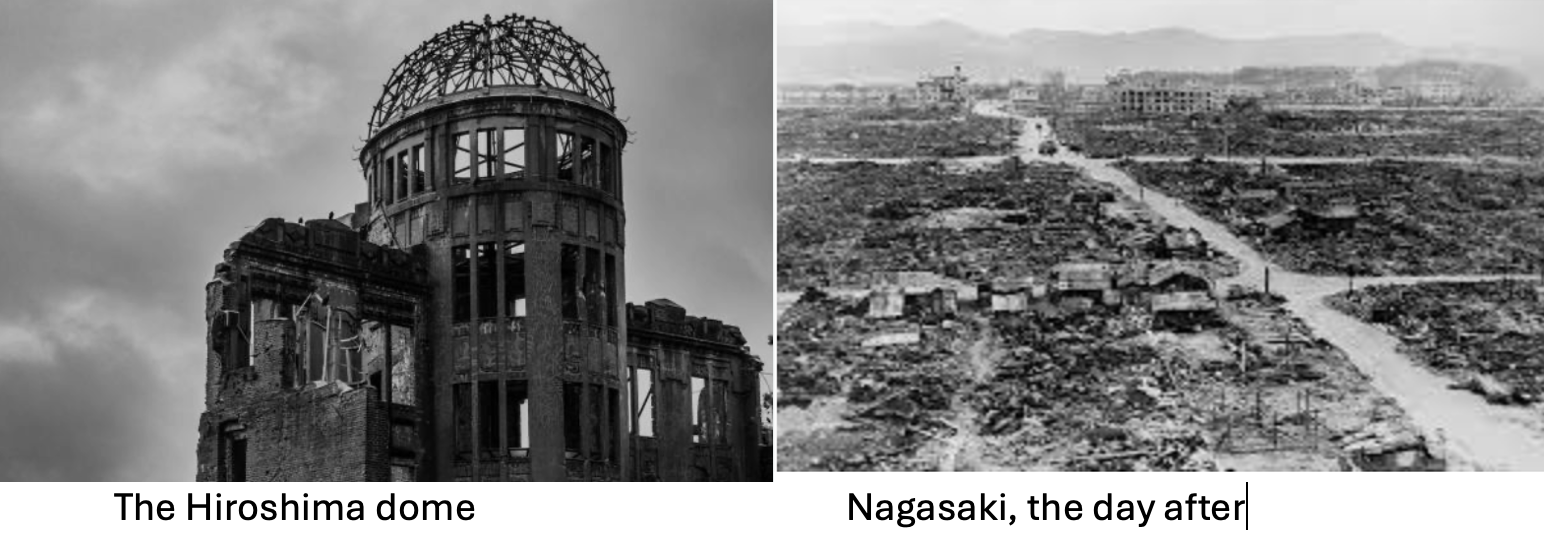
1945: 6 August, Hiroshima; 9 August, Nagasaki

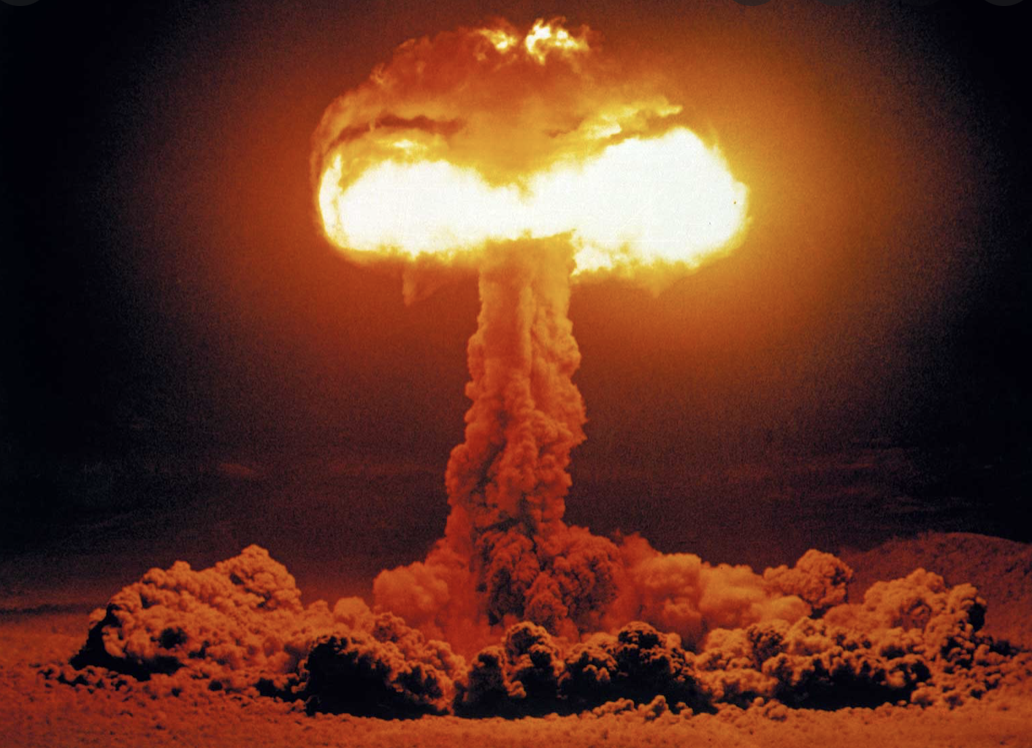
Seventy nine years ago, twice and never since then, nuclear weapons were used in war. One bomb on Hiroshima, one bomb on Nagasaki. Blast, fire and radiation killed between 90,000 and 166,000 people in Hiroshima and from 60,000 to 80,000 in Nagasaki. Those are the estimated figures for deaths by the end of 1945; there have been additional deaths since as a result of radiation-caused cancers.

The destruction of Hiroshima and Nagasaki serves as reminder of what US President and wartime commander Dwight D Eisenhower called “that awful thing” can do. It reminds us that hostile rhetoric and throwaway remarks about using nuclear weapons are inhumanly irresponsible.

NB: Eisenhower, like almost all the most senior US military commanders of the time, believed using the nuclear bombs on Japan was unnecessary and ineffective; it was not the atomic bombing that persuaded Japan to surrender, they concluded, but the Soviet offensive in Manchuria.

World order §5a: Laws and norms – and the ICJ speaks on Israel

The International Court of Justice – the highest legal body in the UN system – has issued an advisory opinion (i.e., a legal ruling) about Israeli settlements on the West Bank.

The 80-page judgement refers seven times to “Israel’s unlawful presence in the Occupied Palestinian Territory”, explains why and how it is unlawful. Israel’s presence, the court makes clear, violates “the prohibition on the acquisition of territory by force and the right to self-determination of the Palestinian people” (paragraph 267). Since the presence is against international law, “Israel has an obligation to put an end to those unlawful acts” (paragraph 268). Further, “Israel is also under an obligation to provide full reparation for the damage caused by its internationally wrongful acts to all natural or legal persons concerned” (paragraph 269).

This is not the first time the ICJ has declared against Israel’s occupation of the West Bank; it did so 20 years ago. What I found striking, since I am thinking a lot and writing about the shaky condition of world order today, is that the ICJ is also clear about other states’ obligations:

“In view of the character and importance of the rights and obligations involved, all States are under an obligation not to recognize as legal the situation arising from the unlawful presence of Israel in the Occupied Palestinian Territory. They are also under an obligation not to render aid or assistance in maintaining the situation created by Israel’s illegal presence in the Occupied Palestinian Territory.” (paragraph 279)

It feels like another acid test for much of the West about right and wrong, law and norms. Is is too much to hope for consistency?

World order §5: Laws and norms – and the double standard

How do you solve a problem like the world order?

We have had one – an order, a way of arranging international relations through institutions, treaties, law and norms – for virtually eight decades since the end of World War II. It has had its ups and downs and gone through some changes, though nothing fundamental. But now, so much seems to be going wrong at once – more armed conflicts with rising death tolls, worsening ecological disruption, growing economic inequalities and fragmenting social cohesion in numerous countries.

It all adds up to system failure on a world scale. This post, number 5 in a series based on the introductory chapter to the recently released SIPRI Yearbook 2024, focusses on the importance of laws and established norms in the world order.

Continue reading

World order §4: Conflict management in a disordered world: the Security Council and Gaza

During the 2020s, on current trends, four times as many people (or more) will die in war as in the first decade of this century. Since 2010, the number of armed conflicts each year has almost doubled. The number of refugees has more than doubled in the same period. Meanwhile the world spends vastly more on the military than ever before, 2.443 trillion US dollars in 2023, compared to about 1.1 trillion at the start of the century.

What is going on? What has happened – is happening – to the world and to conflict? How come conflict management doesn’t seem to be working any more?

This post is number 4 in a series, based on the introductory chapter to the recently released SIPRI Yearbook 2024, asking, What world are we shaping for ourselves in the coming decades if these trends continue unchanged? 

Continue reading

World order §3a: NATO enlargement

Most of NATO is involved, together with other states that are politically defined as part of the ‘West’, in the war in Ukraine by providing training and equipment for Ukraine’s armed forces and by supporting its government financially and politically. NATO is also involved in another way as part of the Russian narrative that presents the invasions of Ukraine in 2014 and 2022 as forced upon Russia by NATO’s incorporation of eastern European states since the end of the Cold War.

Russian spokespersons and others have treated NATO’s increasing membership as an exculpatory reason for, or a partial justification for, or a proximate cause of, or a contributing factor to Russia’s war against Ukraine. These are arguments worth looking into.

Continue reading

World order §3: The current disorder

The world order is under pressure. For world peace and stability, the core security tasks of the key international organisations such as, above all, the UN and regional organizations such as the African Union (AU) and the Organization for Security and Co-operation in Europe (OSCE) are to manage and reduce conflict and to establish and build peace.

The problem is that for the past decade and more, the overall number and longevity of armed conflicts have increased along with their intractability. These armed conflicts that international mediation or conflict management seem unable to reach or influence are, alongside confrontation between the great powers and generally toxic geopolitics, key markers of the current disorder.  

Continue reading

World order §2: Power, norms, origins and longevity

The world order is under pressure from a combination of political, economic, social and ecological factors, to such an extent that it is not simply weakening but is at risk of cracking, fragmenting and coming to an end. There are some who will cheer because of its many evident flaws over the past 80 years, the injustices and wars it has permitted and even fostered. But be careful what you wish for, folks. Too much of history warns us that doing away with an unjust order does not necessarily mean introducing one that is more fair. And the world order that is staggering today brought some real benefits despite its flaws.

Continue reading

World order §1: Order under pressure

As global security deteriorates, one of the problems both in understanding it (even in knowing what to worry about most) and in figuring out what can and should be done is that so much seems to be going wrong at once. Beyond the individual issues of rising inter- and intra-national conflicts, ecological disruption, economic inequalities and malfunction, and fragmenting social cohesion in so many countries, there is a system failure on a world scale.

That thought directs attention towards the world order — the way in which international relations are arranged through institutions, treaties, law and norms — and the problems that are and have been chipping away at it.

The 2024 Yearbook of the Stockholm International Peace Research Institute (SIPRI) is out now, compiling and reflecting on the key data and trends in peace and security during 2023. In the introductory chapter, I explore the problem of the world order today. The chapter is available in full online. Here on my blog, this and succeeding posts will present the arguments in a somewhat tweaked, less formal and slightly fuller manner, with some updating to cover the way things have moved on.

Continue reading